

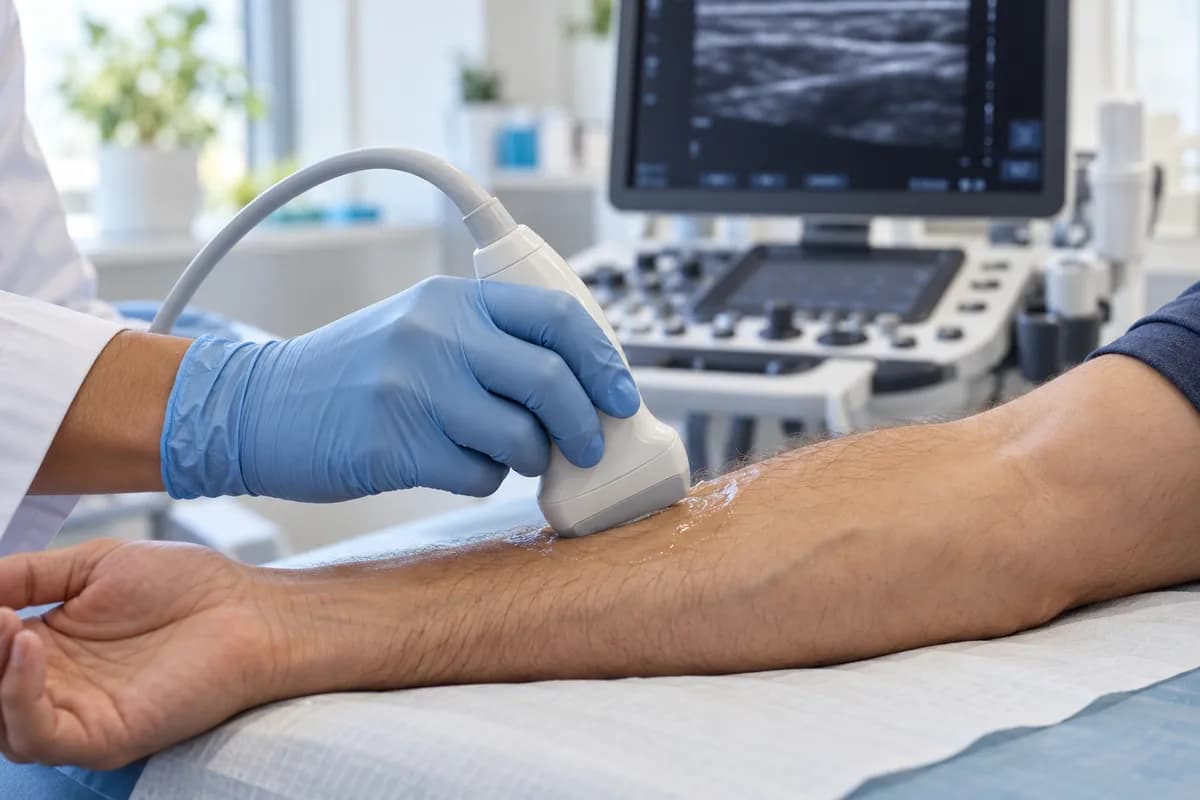
Musculoskeletal (MSK) ultrasound has become an essential diagnostic tool in modern sports medicine and rheumatology practice. Dr. Abdel-Ilah EL AZAMI EL HASSANI, holder of a university diploma in MSK ultrasound (Mohammed V University, Rabat), uses this technology daily to provide fast, precise and non-invasive diagnosis to his patients in Rabat.
What is Musculoskeletal Ultrasound?
MSK ultrasound is a medical imaging technique using sound waves to visualize in real time the structures of the locomotor system: muscles, tendons, ligaments, bursae, cartilage and joints. Unlike MRI, it is immediately available in the office, without ionizing radiation and at lower cost.
Key advantage: MSK ultrasound is the only imaging technique allowing real-time dynamic evaluation — the physician can observe structures in motion to reproduce the patient's exact pain.
Main Clinical Applications
Tendon Pathologies
Ultrasound is the gold standard for tendinopathies. It visualizes micro-lesions, hypervascularization zones (neo-angiogenesis) and tendon calcifications. The most commonly examined tendons are: Achilles, patellar, rotator cuff, posterior tibial and peroneal tendons.
Ligament Injuries
In case of sprain, ultrasound differentiates a simple ligament stretch from a partial or complete rupture, which determines treatment and return-to-sport timing. It is especially valuable for ankle, knee and wrist ligaments.
Muscle Injuries
Muscle tears (strains, partial and complete tears) are perfectly visualized with ultrasound. Precise measurement of lesion extent guides management and predicts recovery time.
Joint Pathologies
Ultrasound detects joint effusions, synovitis, popliteal cysts, chondrocalcinosis and microcrystalline arthritis. It also guides joint injections, peri-tendinous or bursal infiltrations with optimal precision.
Why Choose MSK Ultrasound?
- Immediacy: result available immediately, no waiting for a specialist appointment
- Non-invasive: no ionizing radiation, no contraindication
- Dynamic: real-time movement assessment, impossible with MRI or CT
- Procedure guidance: precisely guided injections and aspirations
- Treatment monitoring: follow-up of tendon or ligament healing