

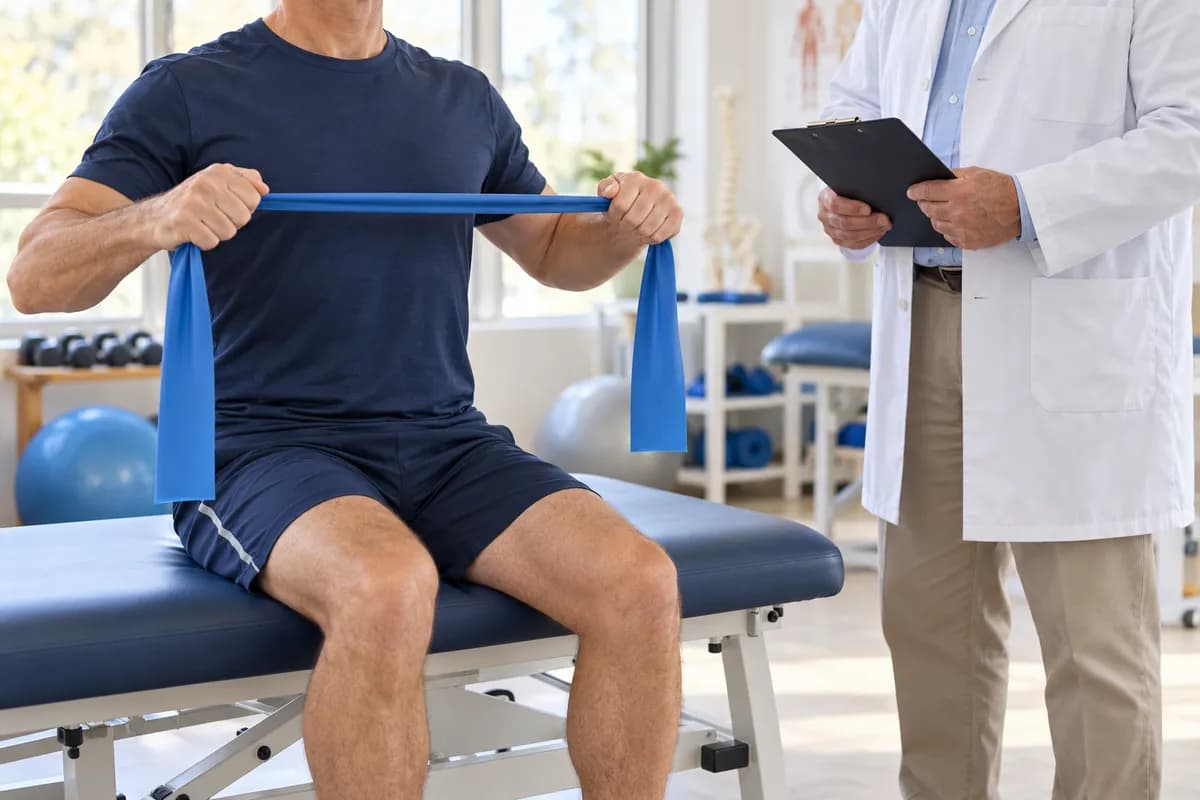
Functional rehabilitation is the medical and therapeutic process allowing a patient to regain their physical, motor and functional abilities after an injury, surgery or chronic illness. As a Physical Medicine and Rehabilitation (PMR) specialist in Rabat, Dr. Abdel-Ilah EL AZAMI EL HASSANI develops personalized rehabilitation programs for each patient.
What is Physical Medicine and Rehabilitation (PMR)?
PMR is a recognized medical specialty aimed at restoring or maintaining the functional abilities of patients. It relies on a multidisciplinary approach integrating physical medicine, physiotherapy, occupational therapy, advanced technology (shock waves, laser, electrotherapy, cryotherapy) and therapeutic education.
To know: Functional rehabilitation is not reserved for severe cases. It benefits anyone wishing to fully recover after an injury, even a minor one, to avoid sequelae and recurrences.
The 5 Phases of Functional Rehabilitation
Phase 1: Clinical Assessment
Rehabilitation begins with a complete medical assessment including history-taking, clinical examination, functional assessment and imaging if needed (MSK ultrasound, MRI). This step is crucial for establishing a program adapted to the patient's real condition.
Phase 2: Pain and Inflammation Management
Before any active rehabilitation, pain and inflammation must be controlled. Techniques used at Dr. EL AZAMI's practice include: analgesic electrotherapy (TENS), cryotherapy, therapeutic ultrasound, and if needed, ultrasound-guided injections.
Phase 3: Joint Mobility Restoration
Passive and active-assisted mobilization techniques progressively restore joint range of motion. Vertebral traction is used for spinal conditions. Stretching and proprioception work are integrated from this phase.
Phase 4: Muscle Strengthening and Proprioception
Progressive muscle strengthening is the core of rehabilitation. Proprioception — the body's ability to sense its position — is intensively trained to prevent recurrences and stabilize joints.
Phase 5: Re-athletization and Return to Activity
The final phase reproduces the patient's specific professional or sports movements. For an athlete, this involves game simulation exercises, sprints, jumps or direction changes according to the sport practiced.
Technologies Available at the Practice
- Extracorporeal shock waves: chronic tendinopathies, calcifications, plantar fasciitis
- Therapeutic laser: anti-inflammatory effect, accelerated healing
- Radiofrequency: osteoarthritis, chronic myofascial pain
- Therapeutic ultrasound: contusions, muscle contractures
- Electrotherapy (TENS, EMS): analgesia, muscle strengthening
- Cryotherapy: acute inflammation, post-exercise recovery
- Mesotherapy: local injections of medications at very low doses